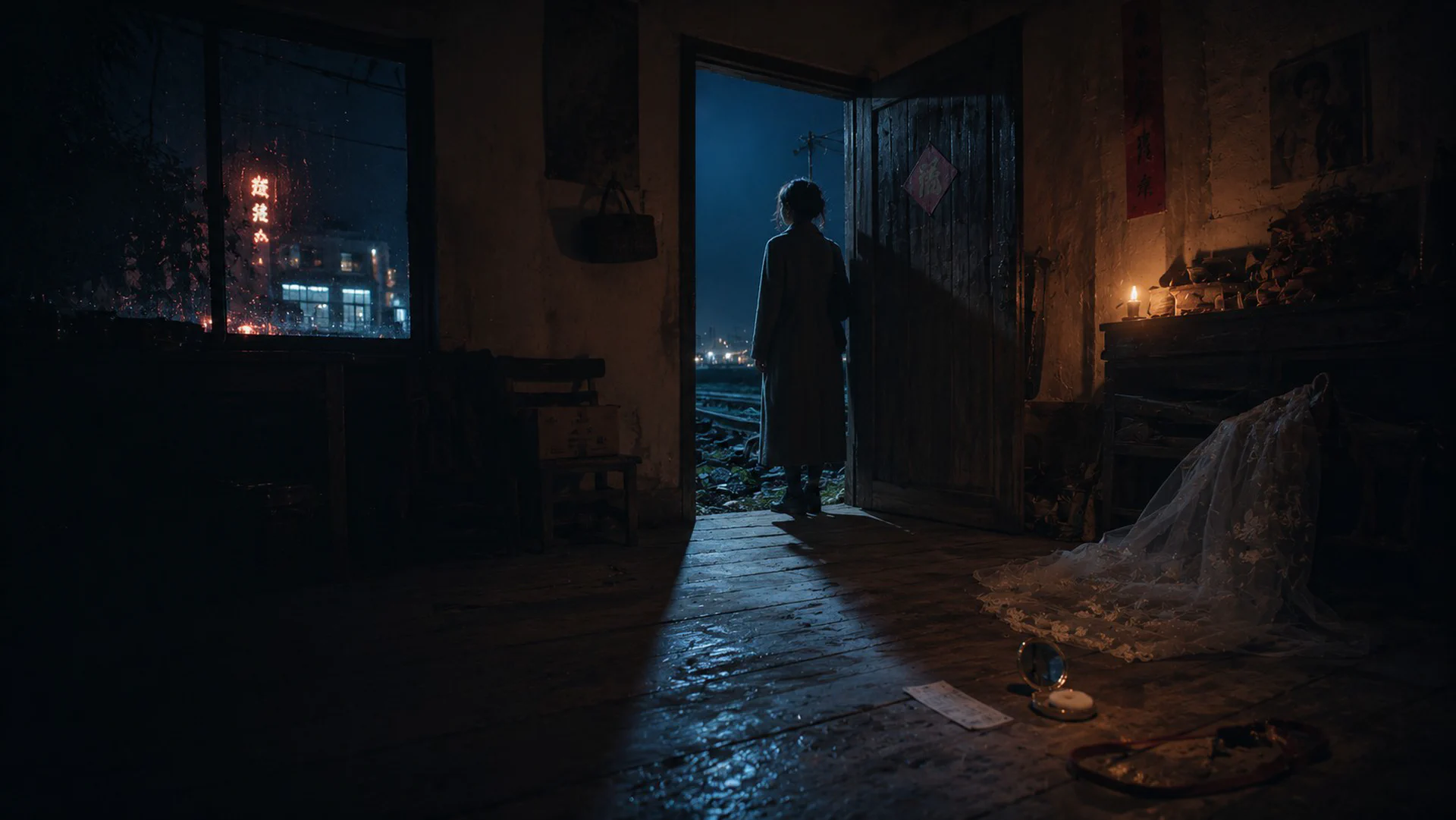
What Happens After Nora Leaves: Departure, Drifting, and New Nomadism of East Asian Women
In 1879, Nora slammed the door and departed, marking the dawn of female self-awareness. Yet in 1923, Lu Xun offered a chillingly realistic retort: “What happens after Nora leaves? She either goes astray or returns.” The harsh truth is that the true cost of freedom is rooted in a brutal struggle for financial and material survival. Over a century later, within the East Asian context governed by Confucian ethics and capitalist forces, contemporary “Noras” have never stopped walking out—but the wilderness they now face has become vastly more volatile and unpredictable.
This curation employs moving images as coordinates to trace the footsteps of these departing East Asian women, casting a steady gaze on the stories that unfold after their departure. The seven selected works, all helmed by female directors, span narrative shorts, anthropological observations, and transnational personal essays. Together, they delineate the intricate realities of individual women breaking free from domestic institutions, economic discipline, and nomadic existences.
Blessed with Burdens and Her Last Day zero in on the shackles binding women on the “eve of departure.” The former strips away the warm facade of “maternal blessings” to confront how motherhood encroaches upon a woman’s life; the latter drags a victim of domestic violence back to her yesterday’s wedding, interrogating her pre-ordained fate as a caged canary. Nora and A Year Apart portray women deeply entrenched in rural and traditional families, capturing their hesitation and awakening when faced with the prospect of leaving. On one side is a rural housewife who retreats out of fear when confronted by the unknown torrent of urban life; on the other is a widowed wife who severs her marital ties to embark on a silent, inward reconstruction by picking up makeup and the piano once more. Blossom in Midnight directly confronts Lu Xun’s historic question through a grassroots narrative, illustrating how a marginalized rural woman reclaims control of her life through sex work. Meanwhile, Myanmar Bride: A story of A zhen, Ma Yong & Han’Ai and Export My Love expand the geography of “departure” into the realm of transnational nomadism. From a Burmese mother putting down roots and thriving wildly on the border, to a middle-aged Chinese woman defying prejudice to travel across oceans via dating apps in pursuit of love and security—these women forge non-traditional alliances and survival orders through rebellious postures amidst foreign lands and generational clashes.
Through this film program, we witness the true cost behind the “myth of departure” for East Asian women. Romantic awakenings are almost always accompanied by fear and retreat, and true freedom must invariably be forged through the visceral, physical struggles of the marginalized and the brutal baptism of secular reality.
Seven films, seven forms of departure. These women step out of their homes, only to find that what awaits outside is a late-night foot reflexology parlor, an unfamiliar border line, a lonely city corner where no one understands them—or that very door they knocked on, only to turn back. Some step forward and then retreat; some walk into the darkest corners; some put down roots in foreign lands; and some only begin to find themselves after their husbands pass away. None of them are flawless victors, nor are they purely tragic figures—they are simply making choices, large or small, within their respective circumstances, and bearing the consequences.
Importantly, the uniqueness of this film program lies not only in the “female destinies being observed,” but also in the fact that the hands holding the camera and the eyes casting the gaze belong to female creators themselves. All seven films are directed by women. They refuse to reduce “female empowerment” to a mere slogan, nor do they cater to a consumerist aesthetic with false myths of independence. Through their lenses, bodily fractures are concrete, survival trade-offs are coarse and gritty, and choices that seem absurd, hesitant, or silently healing are all granted the deepest reverence.
This is more than a record of female destiny; it is a collective expression and spiritual alliance of female creators. On this East Asian soil, when a woman decides to sever the chains of being a “daughter, wife, and mother,” the wilderness she faces is real, the exhaustion is real, and the scars are real. Yet it is precisely these female directors who, with their profoundly vital imagery, honestly construct “rooms of their own” upon the ruins and the wilderness. And this, perhaps, is far more worthy of being witnessed than any romanticized “myth of departure.”
Films in This Program

When the protagonist’s cousin gives birth to a girl, her mother and family sigh outside the maternity ward: “Having a daughter is blessed.” But what exactly lies behind this “blessing”? Through a first-person documentary lens, the film delicately dissects the hidden pain women endure in childbirth, tearing away the warm facade of “maternal blessing” and capturing the countless compromises and sacrifices mothers make in shouldering motherhood.
Abandoning grand sociological narratives, the film uses extremely close handheld photography to capture cold medical instruments, torn flesh, and labored breathing, placing the traditional discourse of “blessed with a daughter” in brutal visual contrast. Before discussing the “departure” of East Asian women, this film serves as an essential pre-text: it shows how many invisible chains named “love and devotion” already bind Nora long before she reaches that door.

Beneath the veil of a perfect marriage, the wife “Meizi” lives a hidden and brutal life—she is a “canary” who has long endured domestic violence with nowhere to hide. On the eve of her decisive choice to leave home for good, a chance surreal moment sends Meizi, covered in wounds, back to the scene of her once-glorious wedding.
The director demonstrates remarkable control over spatial staging. The entire film uses low-key lighting and enclosed compositions, placing Meizi within shadows and geometric lines like a cage, pushing the suffocation of the “canary” to its limit. The camera lingers on her silence before the ruins of the wedding, visual oppression amplifying her inner turmoil without end. This is not an action-driven escape road movie, but a deep close-up of a woman’s psychology approaching the “breaking point” under structures of violence.

A film whose title is itself a declaration, directly echoing Lu Xun’s question. A rural wife trapped in a stifling marriage loves writing poetry in her spare farm work and even reads Lu Xun—already a vast temporal contrast. After meeting a female radio host from the city, she is invited to participate in a program. This is the “Nora-like departure” she has dreamed of, and her husband agrees to send her. Yet when she truly stands at the edge of the city, facing an entirely unfamiliar system, long isolation fills her with deep fear. In the end, she flees back to the village, avoiding the world outside the door.
The director skillfully captures women’s “loss of everyday speech” when confronted with the shock of modernity. Her retreat is not a lack of courage, but the psychological regression a Nora without economic and cultural capital inevitably faces before reality. Departure is sometimes not a lack of romantic impulse, but a lack of the practical capacity to step into the wilderness.

Housewife Huilin is accustomed to confiding life’s ups and downs to the Guan Gong statue at home. After her husband’s death, the grapevine she cherishes withers from over-fertilization, and her life arrives at a delicate crossroads through this “passive widow’s departure.” Unlike fierce rebellion and escape, the film uses extremely restrained camerawork to record an “inward departure.” She does not wail or rage, but quietly picks up long-forgotten hobbies—makeup, piano. Amid memory and release, with the gentleness and resilience particular to East Asian women, she quietly walks out of the ruins of her old life.
The film is filled with static, still-life-like fixed compositions. The director turns the camera toward floating curtains, withered grapevines, piano keys under fingertips—externalizing psychological time as visual still life. She does not leave the physical home, yet step by step she walks out of the ruins of identity as “wife” and “widow,” re-empowering herself within the wreckage of the old life.

A rural woman looked down upon in the city suffers exclusion while working in a big city. To raise medical expenses for her sick family, she finally enters an unlicensed foot massage parlor with no other way out. When her body is priced like fish on a chopping block, she does not fall into the total destruction of moralistic tales. Instead, with real economic income, the stalled “clock” of her life begins to turn again. In what the secular world calls “fall,” she exchanges survival and long-lost confidence.
The director uses long takes that are objective, restrained, and refuse the filter of pity, gazing at the protagonist’s labor in dim rooms. The body is thoroughly instrumentalized here. This refusal of sentimental audiovisual strategy forces viewers to confront the most visceral struggle of marginalized women between earning money, surviving, and reclaiming bodily autonomy.

In mainstream reports, they are often labeled victims of “trafficking and fraudulent marriage.” The director spent more than three months on site, using level-eyed footage to tear through stereotypes. They are “departures” across borders, laboring, putting down roots, and supporting one another on unfamiliar land. In the cracks of language barriers, awkward identity, and cultural conflict, they pave a path of survival with their bodies. This is among the most resilient samples of the transnational Nora in East Asia.
Through long-term observational filming, the camera records these women’s powerfully laboring bodies in border markets and fields. The audiovisual language is coarse with earth and sweat, showing how East Asian women in transnational movement forge informal alliances against structural oppression with tenacious vitality.

In traditional Chinese views of marriage, women over sixty who are divorced or widowed and have children seem already sentenced by the social clock to “emotional death.” Yet this film turns its lens toward four extraordinarily tough Chinese aunties. They may be ordinary mobile saleswomen in daily life, yet choose on Tinder to cross oceans seeking American husbands. Facing language barriers and surrounding prejudice, they remain true to themselves, attempting to “export” themselves to the other shore.
This is the most rebellious work in the program. With brisk editing and documentary humor in following shots, the film presents aunties’ proactive moves in the digital age and cross-cultural contexts. This absurdity precisely dissolves the invisible shackles East Asian society imposes on the group called “middle-aged and elderly women.”
About the Curator
estivate