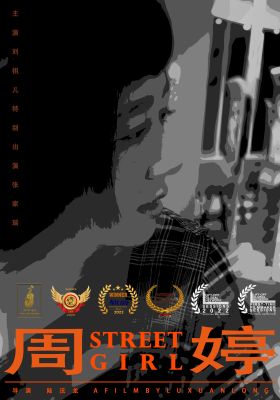
Street Girl
LU Xuanlong • 2022
Ting Zhou likes to appear in disguise on the street at night, hooking up with those lonely men. After having sex with a strange man one night, subtle feelings developed between them. On the other hand, Zhou is under pressure on preparing for her dissertation defence. When she wanted to pour out with the man, she found that he’s lost contact. Being back to the street, Ting Zhou continues her life with confusion and lust, hoping to meet the man once again. One day when she saw the man in the crowd, it appeared that he was associating with another boy. Ting Zhou did not come up, but left silently.
CAST & CREW
DIRECTOR'S STATEMENT

LU Xuanlong
Director
The film was shot with fixed lenses, almost one shot at a time, using live sound and natural light as much as possible, anticipating that the spirit of the New Wave can also be carried forward on this land. I am always wondering if the film language is similar to what Robert Bolaño described as Mexican poetry, which is “trapped between Octavio Paz and Pablo Neruda, in other words, sandwiched between a rock and a hard stone. ” That is to say, could there be another kind of form in David Griffith’s montage and André Bazin’s long lens? When I put this idea into practice, I found, sadly, that I did not deviate from Godard’s “skipping” technique in essence, but that I differed from his style in concrete terms. What I hope to try is to connect multiple fixed lenses in the same scene to restore the “impossibility” of continuous spatio-temporal experience after the long lens is broken. Is this “impossibility” a kind of falsification that can “truly” show the coherence of spatio-temporal with the long lens that is commonly advocated by us? Or is it just an idealist deception in a materialist context? I tried to use the central idea of Maurice Blanchot’s novel to express the impossibility of love that each of us is a lonely individual above the clamour of the (post-) modern society.